Copyright 2020 Greenstone Media Consulting, LLC
American Broadcasting Company - Seattle - 1929

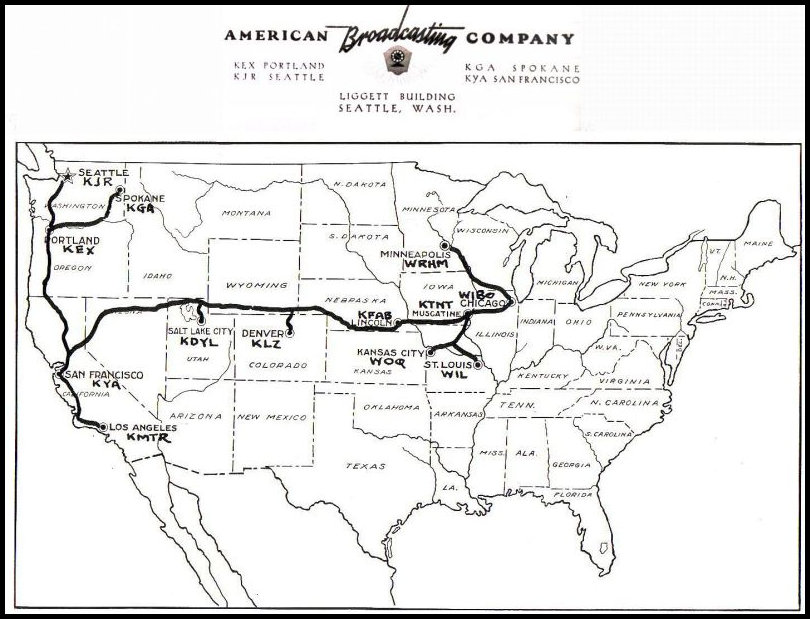
Map courtesy
of theradiohistorian.com
of theradiohistorian.com
.png)
Paley making the "connection" to feed Columbia programming to ABC (courtesy of theradiohistorian)
Expanding ABC
Linden’s acquisition of control over NRS in Spring,
1928 brought him the four radio stations NRS
owned as well as the existing American Broadcasting Company (ABC) name and
circuit connections. While ABC had apparently previously been an informally
assumed business name, Linden opened an ABC New York City sales office in April
and formally incorporated the American Broadcasting Company in the state of
Washington in November 1928. Both gave some indication of his intention to
compete on a national scale on the existing networks’ home grounds.
While the ABC programming had initially been more sporadic, under Linden’s more
ambitious ABC vision the network’s program schedule debuted on December 22,
1928, with a three-hour special sponsored by the
Union Oil Company followed by an expanded schedule
of network offerings.
Linden also contracted with the Columbia
Broadcasting System whose network at that time
ended in Omaha and was, therefore was anxious to
extend its coverage in the West. Under the
arrangement ABC picked up Columbia’s programming
in Omaha and relayed it to ABC’s affiliated stations.
Occasionally, Columbia would reverse the phone
lines and relay ABC’s programs to the Eastern half of
the U.S. ABC’s first carriage of a Columbia program occurred on October 9, 1928
and consisted of a performance by the popular vaudeville team Moran and Mack as
“The Two Crows”. And on January 9, 1928, Columbia formally inaugurated its
connection with Linden’s ABC.
In 1929, the ABC rapidly expanded and placed AT&T line orders to connect stations
both in California as it simultaneously began
moving east. According to Homer
Pope, who began working at KJR/ABC in
mid-1928, initially ABC used telegraph
lines to link the stations. There was
precedent for that since the NBC Blue
Network had started out linking its
stations with Western Union lines. But
the telegraph lines provided inferior
quality and Linden gradually moved to
connect ABC’s stations with the more
expensive AT&T long-distance circuits.
On January 6, 1929, new telephone circuits were
added to
feed additional affiliated ABC stations in Omaha
(KOIL),
Denver (KLZ), Salt Lake City (KDYL) and Los Angele
KMTR
(which later took the call sign KLAC). The burgeoning network now had eight
stations. At its height, ABC's connections went as far east as Chicago while the
network was simultaneously announcing new affiliation agreements with stations all
the way to the Atlantic seaboard.
America's history through the lens of 20th century broadcast media
