
America's history through the lens of 20th century broadcast media

Copyright 2020 Greenstone Media Consulting, LLC
Broadcast History
(Keep Growing Wiser Order of) Hoot Owls
KGW, Portland OR
1923 - 1933
NBC-Red
1928 - 1932 occasional
KAST, Astoria, OR
1930 - 1932
Occasionally carried on
KLX, San Francisco
1923 - 1933
NBC-Red
1928 - 1932 occasional
KAST, Astoria, OR
1930 - 1932
Occasionally carried on
KLX, San Francisco
See also KGW Radio
Harry Grannatt
Hoot Owls
Mel Blanc

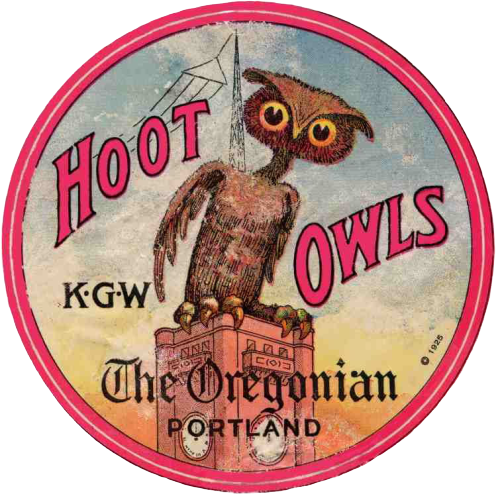
Early in 1933, the Hoot Owls ended their ten-year KGW run. Creating
and presenting the program on a largely volunteer basis was draining
but the passage of time had also taken its toll. Some cast members,
like Haller and Blanc, had moved on. Then, in late April 1931, death
claimed Tige Reynolds, the Oregonian cartoonist whose on-air
presence and visual representations of the Hoot Owls had helped cast
the program’s spell. Quickly, the Hoot Owls cancelled their intended
May 1 program and gathered for a spontaneous Reynolds memorial
before the KGW microphones.
Unfortunately, that event proved a sad rehearsal for the program’s
greatest loss, a September 1, 1932 heart attack which killed Grand
Screetch Charles F. Berg. Berg had some history of ill-health and it
was his first heart attack, in 1922, which brought son, Forrest, to
Portland to assist in his father’s business. Berg, one of Portland’s
“most energetic civic leaders and keenest business minds”, was
editorially mourned by the Oregonian as: “[a] rare
cavalier...far-visioned, competent...boyish of heart, with a mature
wisdom and purpose. [H]e believed, as essential to living, that
laughter is the tonic of the race....In twenty years there has been
little of constructive moment to the city of Portland that did not
summon Charlie to an unselfish task...Charlie Berg was one of the
few.”
The death of this much-beloved Portland figure occurred on a
Thursday evening late in the Hoot Owls’ summer-long vacation from
radio. Notwithstanding their summer hiatus, the following day, on
Friday September 1, the Hoot Owls gathered before the KGW
microphones for a brief, unscheduled broadcast eulogy: “These are
the Hoot Owls assembled in regular meeting in the home roost of
KGW. We are gathered tonight to pay brief and simple homage to
Charles F. Berg, grand screetch and founder of the Hoot Owls, whose
sudden passing gives us pause to scatter that sunshine which he
radiated throughout his life - to his family and countless friends. Ten
years of happy service by Mr. Berg made his name synonymous with
the name Hoot Owls and we aim to carry on, as he would have us
do, his simple creed - ‘service to fellow men.’
With KGW music director Abe Bercovitz playing “Ehli, Ehli,” a
Jewish song of mourning, on the violin
(both Berg and Bercovitz were
Jewish), the Degree Team and the
audience all broke down on air.
Following Berg’s death, the Degree
Team reported their firm intention to
continue - but it wasn’t meant to be.
Following the Berg eulogy and the
conclusion of their summer hiatus, on
September 30, 1932 the Hoot Owls returned to their regular
broadcasting schedule. They promoted a significant Hoot Owls skit,
“Africa Squeaks,” for their October 21 program. The title was a
parody of the 1930 documentary/travelogue "Africa Speaks". The
Hoot Owls even prepared their customary promotional materials
including a silly photo (at right, left to right,Harry Grannatt, Dean
Collins and Frank Sardam) -- but their spirit seemed to be waning.
Likely heavily preoccupied with personal and professional matters,
Forrest Berg never returned to the regular program following his
father’s death. As one cast member put it: “With Charlie gone, and
the Bishop – the heart went out of it.”
Rallying for the traditional Hoot Owls Christmas broadcast for 1932,
the Hoot Owls limped into 1933 with a scheduled January 6 program
but without Berg in their roost the void must have increasingly
seemed overwhelming. It seems unlikely that, as the Hoot Owls
entered the KGW studio on January 6, 1933 for their 518th program,
they intended it would be their final broadcast. Given the program’s
history and prominence, it would seem
that a grand finale edition would have
been prepared if the program’s
conclusion had been anticipated. A skit
had been prepared for the program and
customary advance publicity appeared -
all with no hint that it would be the Hoot
Owls’ final weekly episode. But it was.
Perhaps during the broadcast the Hoot Owls realized just how
difficult it was to go on. Perhaps they had some sense that the
program wasn’t up to their customary standard following the deaths
of Berg and Reynolds and the departures of Blanc, Sumner, Forrest
Berg and others. Whatever the circumstance which caused the
program’s conclusion, no public explanation was given for their
sudden exit. The following morning, in the January 7, 1933
Oregonian, the paper’s “Behind the Mike” column contained their
simple one-sentence epitaph: “The Hoot Owls last night broadcast
their final program and retired to their woods for good.”