America's history through the lens of 20th century broadcast media

Copyright 2020 Greenstone Media Consulting, LLC
Broadcast History
(Keep Growing Wiser Order of) Hoot Owls
KGW, Portland OR
1923 - 1933
NBC-Red
1928 - 1932 occasional
KAST, Astoria, OR
1930 - 1932
Occasionally carried on
KLX, San Francisco
1923 - 1933
NBC-Red
1928 - 1932 occasional
KAST, Astoria, OR
1930 - 1932
Occasionally carried on
KLX, San Francisco
During its ten-year run, the program was always “sustaining” – meaning
that KGW accepted no commercial announcements during the
broadcast. “[It was]...a gift to the people of Portland from KGW and
the Oregonian,” former KGW announcer Bob Thomlinson later recalled.
While it appears that musicians and some other entertainers were
paid, the Degree Team, which wrote and centrally performed the
program, did so entirely as volunteers.
In 1924, the Hoot Owls - after due deliberation in “business meetings”
held on the air -- authorized jeweler Frank Haener’s creation of “Hoot
Owl pins” which sold fast. Offered in silver for 75 cents or gold for
$1.50, sales proceeds were devoted to charities selected by the
Degree Team. Following the initial 1923 joint effort with the Police
Department, which resulted in the creation of the Hoot Owls Sunshine
Division, the 1924 Hoot Owl pin sales seem to have crystallized the
program’s succeeding long history of using the broadcasts for broad
charitable purposes.
Eventually, the Hoot Owls -- heavily influenced by Episcopal Bishop
Walter Taylor Sumner’s energy and interests -- focused their charitable
initiatives in two areas which the Hoot Owls referred to as their
“divisions.” The Rainbow Division and the Sunshine Division eventually
became so well-known that they ceased to be referred to with any
Hoot Owls’ reference - they simply became known as the Rainbow
Division and the Sunshine Division, each being commonly understood
to be elements of the “Keep Growing Wiser Order of Hoot Owls.”
The Rainbow Division,
which was formed to
provide radio sets to
“shut-ins who otherwise
would be without this or any
other form of
entertainment,” began very
early in the program’s
history. Under its auspices,
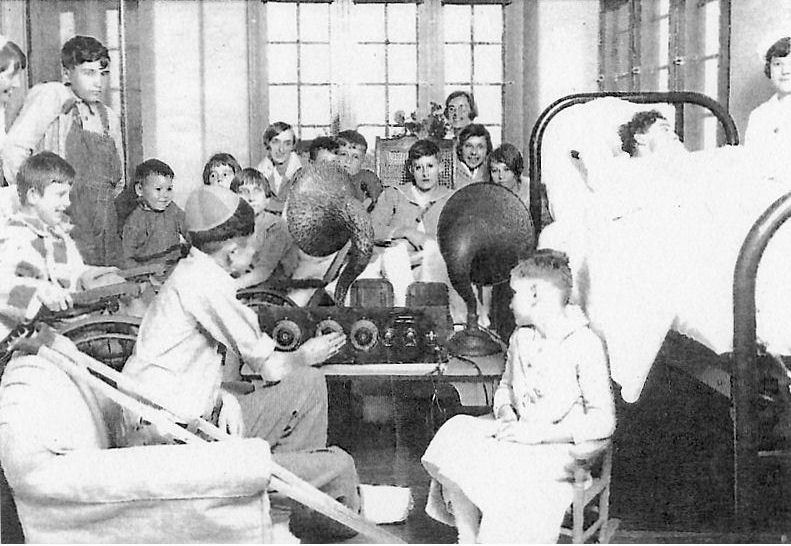
1,300 radios were installed by KGW technicians
in locations like the Oregon State Tuberculosis
Hospital and the Multnomah County farm,
(illustration shows children at Doernbacher
Children's Hospital listening to a Rainbow
Division radio installation) The Rainbow
Division also established a trust fund to provide
medical care for orphans.
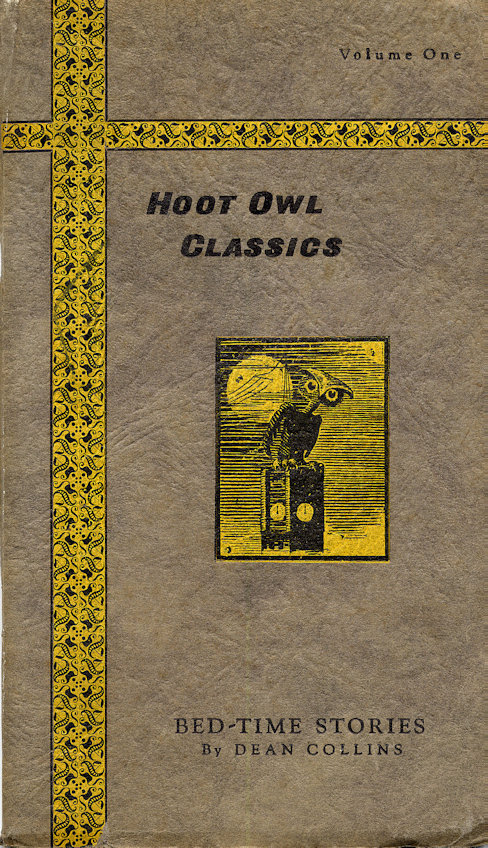
Two volumes of material written for the Hoot
Owls were published, Hoot Owl Classics,
Volumes 1 and 2, the first contained material
penned by Dean Collins; the second by Harry Grannatt, included
poems, jingles and short stories written for the program. The second
also contained unattributed cartoon art by Tige Reynolds. Both
volumes were published under the imprimatur of the Rainbow
Division, Portland, Oregon, - with paper and printing all donated - and
all sales proceeds went to the Rainbow Division’s work.